If your cycle feels unpredictable, frustrating, or completely out of sync, you are not alone.
For many women, polycystic ovary syndrome (PCOS) does not begin with a diagnosis.
It begins with subtle changes that gradually become impossible to ignore.
A cycle that never quite stabilises.
Skin that suddenly shifts.
Unexplained weight fluctuations.
Mood changes that feel out of your control.
And beneath it all, a quiet question:
“Why does my body feel out of rhythm?”
At nutropia, we believe that understanding your body is the first step towards supporting it — intelligently, not impulsively.
One approach that has gained increasing attention is seed cycling.
But does it truly have a place in PCOS management?
Let’s explore this properly.
What Is Seed Cycling?
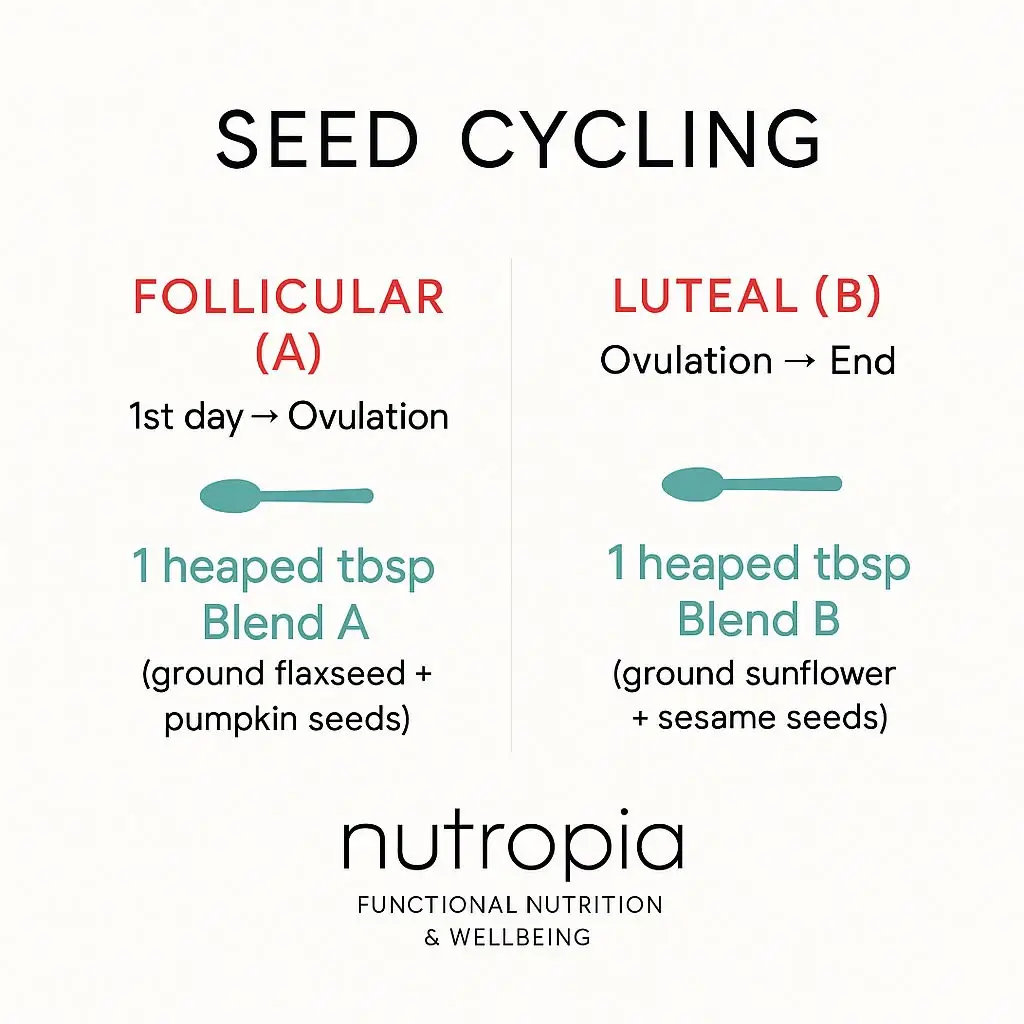
Seed cycling is a nutritional strategy that aligns specific seeds with the two main phases of the menstrual cycle, with the aim of supporting hormonal balance.
The protocol is simple:
Follicular Phase (Day 1–14)
→ Flaxseeds + Pumpkin seeds
Luteal Phase (Day 15–28)
→ Sesame seeds + Sunflower seeds
Each seed is selected for its unique micronutrient and bioactive profile, which may interact with hormonal pathways.
The Science Behind the Seeds
While seed cycling itself has limited direct clinical evidence, the nutritional components of these seeds are well studied.
Flaxseeds
Rich in lignans, which may influence oestrogen metabolism and support hormonal modulation.
Pumpkin Seeds
A valuable source of zinc, essential for ovulation, insulin signalling and endocrine function.
Sesame Seeds
Contain lignans and healthy fats that may contribute to oestrogen balance and antioxidant defence.
Sunflower Seeds
High in vitamin E, which plays a role in reproductive health and may support the luteal phase.
Collectively, these nutrients contribute to:
- hormonal signalling
- inflammation regulation
- metabolic support
— all of which are relevant in PCOS physiology.
Why This Matters in PCOS
PCOS is not just about the ovaries.
It is a complex endocrine condition involving:
- insulin resistance
- androgen excess
- ovulatory dysfunction
This means that any supportive strategy should ideally:
- improve metabolic balance
- reduce inflammation
- support hormonal regulation
Seed cycling does not “treat” PCOS but it may help create a more supportive internal environment.
What Can You Realistically Expect?
Let’s be clear because this is where most content gets it wrong.
Seed cycling is:
✔️ A low-risk, food-based approach
✔️ Nutrient-dense and easy to implement
✔️ Supportive of consistency and routine
But it is not:
❌ A cure for PCOS
❌ A replacement for targeted nutritional support
❌ A guaranteed way to regulate cycles
Some women report:
- improved cycle awareness
- subtle hormonal improvements
- better dietary consistency
Others may notice little change.
And that is completely normal.
Where Seed Cycling Fits in a Smarter PCOS Strategy
At nutropia, we never rely on a single intervention.
Because PCOS requires a multi-layered approach.
The foundation always includes:
- improving insulin sensitivity
- supporting ovulation
- correcting micronutrient deficiencies
- reducing chronic inflammation
Seed cycling can be added as a complementary layer — not the core solution.
Think of it as:
a supportive rhythm, not a standalone strategy
How to Implement Seed Cycling (Practically)
If you choose to try seed cycling, consistency matters more than perfection.
A simple approach:
- 1 tablespoon of each seed daily
- freshly ground where possible (especially flaxseed)
- added to yoghurt, smoothies, oats or salads
If cycles are irregular:
- you may follow the moon cycle (28 days) as a guide
- or simply rotate every two weeks
Nutropia Insight
In a world full of quick fixes, seed cycling offers something different.
Not intensity.
Not extremes.
But rhythm.
And sometimes, that is exactly what the body needs.
However, true progress in PCOS comes from:
- precision
- consistency
- and evidence-based support
Seed cycling can be part of that journey —
but it should never replace a strategy designed around your physiology.
References (Harvard Style)
- Azziz, R. et al. (2016). Polycystic ovary syndrome. Nature Reviews Disease Primers.
- Barrea, L. et al. (2021). Nutrition and PCOS: role of dietary patterns. Nutrients.
- Gillingham, L.G. et al. (2011). Dietary fats and metabolic health. Advances in Nutrition.
- Mumford, S.L. et al. (2014). Dietary nutrients and reproductive hormones. Human Reproduction.
- Thompson, L.U. & Ward, W.E. (2002). Flaxseed and lignan effects on hormones. Nutrition and Cancer.